Borough High Street, London SE1 1JA
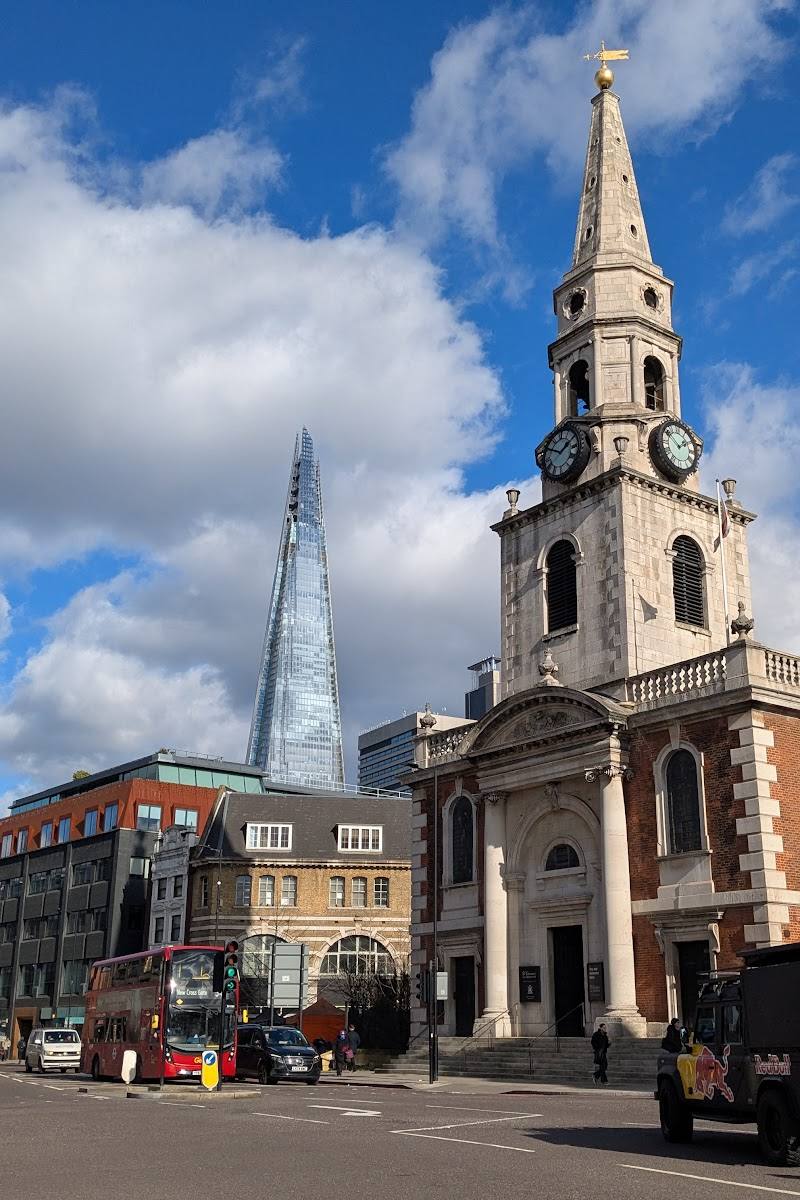
St George the Martyr, Southwark
Church
Place photograph
4.1
Wildland
Under 1 hour
Time
Check
Cost
Atmospheric
Feel
Why it's Wildland
4.1A working Southwark church with a layered local story: a Roman-road setting, pilgrimage routes, and a close connection to Charles Dickens’s Little Dorrit.
This is not a wild landscape, but it earns its place as a compact, unusually layered heritage stop. Its setting on Borough High Street brings together Roman-route history, Canterbury pilgrimage and Dickens’s Southwark; the surviving Marshalsea prison wall nearby gives that literary connection a physical trace.
Atmospheric
Find your way
Open mapBorough High Street, London SE1 1JA
Opening map…
Know this place a little better?
The experience
Allow a short visit to the church, then look for the nearby Marshalsea prison wall and follow Borough High Street’s historic-travel story. Confirm church access and opening before setting out.
Things to do
Visit the church
Explore St George the Martyr as a Southwark church on Borough High Street. Confirm visitor access and current opening arrangements before travelling.
Under 1 hour
Find the Marshalsea connection
Look for the surviving Marshalsea prison wall nearby, which the supplied local-history account connects with St George the Martyr and Dickens’s Little Dorrit.
Follow the Borough High Street story
Explore the street’s history as an old route into London and its connection with travellers, coaching inns and Canterbury pilgrims.
Make a day of it
Quick escape · Under 1 hour
Quick Escape
- 01
Check that the church is open to visitors before setting out.
- 02
Visit St George the Martyr and take in its Borough High Street setting.
- 03
Look for the nearby surviving Marshalsea prison wall, associated in the supplied source with the church and Little Dorrit.
Half day · Half day
Make a Half Day of It
- 01
Begin at St George the Martyr, checking access before visiting.
- 02
Explore the nearby Marshalsea wall and the church’s Dickens connection.
- 03
Continue along Borough High Street, whose history as a route for travellers and pilgrims is described by the supplied Southwark Cathedral walking-tour source.
Verified history
A supplied account of a church visit describes St George the Martyr as a Georgian church and says it is the third church on the site. In a recorded conversation, the church’s director describes the site as lying on an old Roman settlement and at the meeting point of Roman routes; he notes that a Roman temple beneath it is speculation, not an archaeological finding. A local-history account links the church and nearby Marshalsea wall to Charles Dickens’s Little Dorrit, including the novel’s church wedding. A separate Southwark Cathedral source describes Borough High Street as an old Roman road and records its association with travellers, inns and Canterbury pilgrims.
Folklore & legend
No specific local legend is substantiated by the supplied sources. The claim that a Roman temple lies beneath the church is explicitly presented in the recorded conversation as unproven speculation, not established history.
Hidden details
The nearby Marshalsea wall — A surviving fragment of Marshalsea prison wall is described as being by the church, giving a tangible point of reference for the area’s Dickens associations.
Roman roads and a carefully qualified temple story — The church director describes the site as associated with Roman activity and old routes. A Roman temple beneath the church is mentioned only as an unproven possibility.
When to go
· When visitor access is confirmed and outside services.
The supplied sources do not identify a seasonal highlight.
Urban church visit; no weather-specific advice is supported by the supplied sources.
Worth pairing with
Borough High Street heritage walk
Southwark Cathedral describes a local walking tour focused on Borough High Street’s Roman-road and pilgrim history. The referenced tour is bookable and has specific terms; check current details with the organiser.
What to look for
- 01
Look for the Marshalsea prison wall nearby, described by a supplied source as a surviving remnant
- 02
notice how Borough High Street’s position as an old route connects the church to Southwark’s stories of travellers and pilgrimage.
The story
Literature, Archaeology
Best time to go
Year-round; check access before making a special trip.
Visit when the church is confirmed open and, if possible, outside services. The supplied information does not establish a best season or time of day.
How long to spend
Under 1 hour
Perfect for
History lovers
Before you go
Address
Phone
Website
Listed hours
- Monday: 9am-5pm
- Tuesday: 9am-5pm
- Wednesday: 9am-5pm
- Thursday: 9am-5pm
- Friday: 9am-5pm
- Saturday: Closed
- Sunday: Closed
Check before visiting.
Google rating
Practical information
Opening & access
A church on Borough High Street. The supplied source reports weekday opening hours, but access and hours are not confirmed by the church’s official website here. Check before visiting; respect any services or other restrictions. Access arrangements are unconfirmed. Check before visiting; do not enter private land or restricted structures.
Check before visiting
Parking
Check before visiting.
Check before visiting
Toilets
The source row reports a toilet; confirm availability before visiting.
Food & drink
Check before visiting.
Check before visiting
Dogs
Check before visiting.
Check before visiting
Accessibility
The source row reports a wheelchair-accessible entrance. Internal accessibility and facilities are not confirmed; check before visiting.
Check before visiting
Cost
Check before visiting.
Check before visiting
Gallery
Place photographsKeep exploring
Around St George the Martyr, Southwark
Within 50 km · approximate straight-line distances