North-east edge of Hyde Park, London W2 2EU, near Marble Arch and Oxford Street.
Speakers' Corner
Unusual place
Place photograph
6.2
Wildland
Under 1 hour
Time
Check
Cost
Atmospheric
Feel
Why it's Wildland
6.2A Hyde Park tradition of public speech and protest took shape in the mid-19th century. The area was formally set aside for public speaking in 1872; Karl Marx, Vladimir Lenin and George Orwell are among the figures associated with speaking here.
Speakers' Corner is unusual not for a grand monument but for a living public tradition: a place where the argument itself is the attraction. Its story links modern free speech and protest with Hyde Park’s older history of public assembly.
Atmospheric · Quirky
Find your way
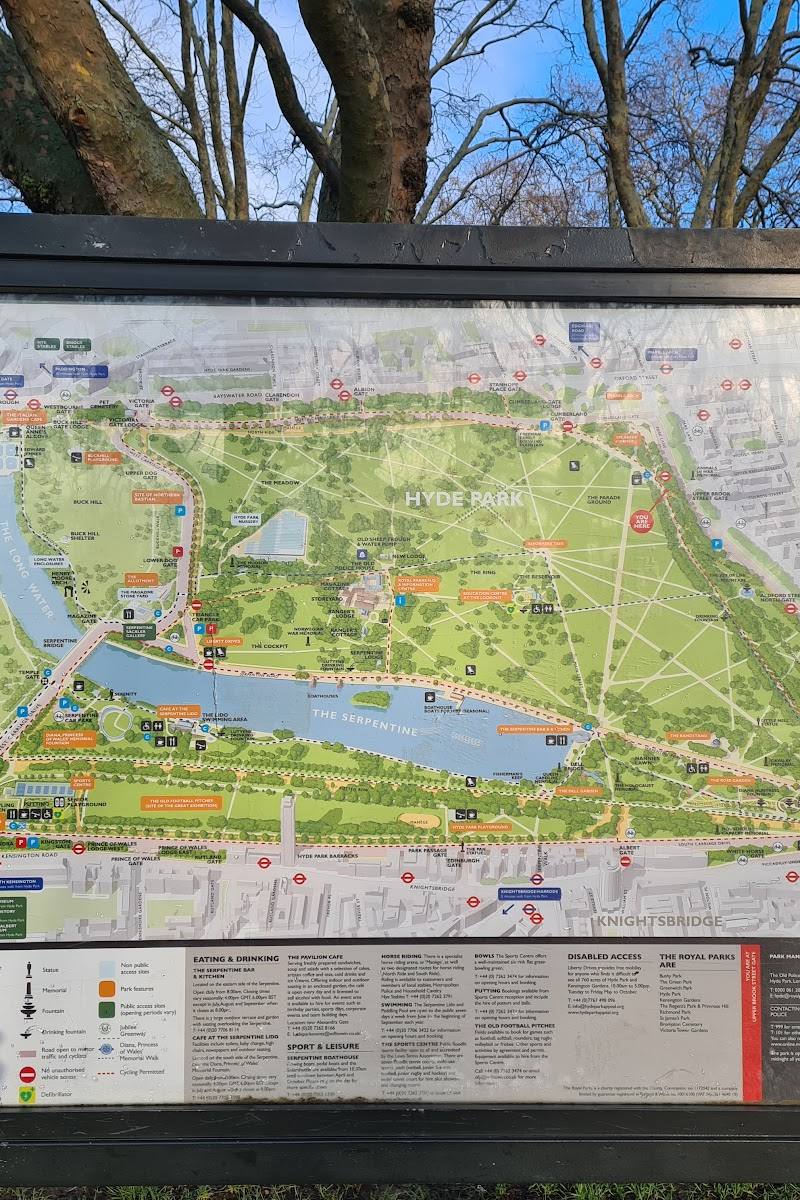
Open mapNorth-east edge of Hyde Park, London W2 2EU, near Marble Arch and Oxford Street.
Opening map…
Know this place a little better?
The experience
Come for the tradition of public debate, then use the Royal Parks’ account to understand how protest, free speech and Hyde Park’s older history of public assembly meet at this corner.
Things to do
Listen to a Sunday debate
The Royal Parks says crowds still gather here on Sunday mornings to hear speakers. Treat the programme and current conditions as variable, and check before travelling.
Under 1 hour
Trace the protest story
Read the site through the Royal Parks’ account: the 1866 Reform League protests, the 1872 legislation and the longer tradition of demonstrations in Hyde Park.
Under 1 hour
Make a day of it
Quick escape · Under 1 hour
Hear the argument
- 01
Visit Speakers' Corner on a Sunday, when the supplied sources describe speakers and crowds gathering.
- 02
Listen to the debate and observe how the site functions as a public speaking space.
Verified history
The Royal Parks traces the modern origins of Speakers' Corner to 1866, when a Reform League meeting demanding an extension of the franchise was suppressed. After demonstrators found Hyde Park locked, they tore up railings; three days of rioting followed. In 1872, the Parks Regulation Act established a right to meet and speak in Hyde Park under regulations. The Royal Parks also records that Karl Marx, Vladimir Lenin and George Orwell were known to use the area to demonstrate free speech, and that suffragette meetings took place in Hyde Park from 1906 to 1914. Nearby Tyburn was the site of executions: the Royal Parks says its gallows were installed in 1196 and dismantled in 1783, with more than 50,000 people executed there by then.
Folklore & legend
A connection between Speakers' Corner and the condemned person's final speech at Tyburn is sometimes suggested. The Royal Parks describes Tyburn’s execution speeches and the later continuation of protest in Hyde Park, but the supplied source does not establish a direct origin for Speakers' Corner in that custom.
Hidden details
The 1872 legal turning point — The Parks Regulation Act of 1872 established the right to meet and speak in Hyde Park subject to regulations. The legally defined speaking area extends beyond the spot where people usually congregate.
A protest that began with locked gates — The Royal Parks recounts that demonstrators in 1866 found Hyde Park locked and tore up hundreds of yards of railings to gain access; three days of rioting followed.
Suffragette meetings in Hyde Park — The Royal Parks records that suffragettes held meetings in Hyde Park from 1906 to 1914, including a Women's Day gathering on 21 June 1908, when 250,000 women marched to hear 20 speaking platforms.
When to go
· Sunday morning, when the Royal Parks says crowds may gather to listen to speakers; check current information before visiting.
The supplied sources support Sunday as the customary time for speeches, but do not establish a seasonal advantage.
Check the forecast and current park information before visiting; no site-specific weather guidance is supported by the supplied sources.
Worth pairing with
Hyde Park
Speakers' Corner is on the north-east edge of Hyde Park. The supplied Royal Parks source places it within the park but does not provide a specific walk itinerary.
What to look for
Notice the contrast between the ordinary park setting and the idea of a place formally set aside for public speaking. The supplied sources do not identify specific surviving markers or physical details at the site.
The story
Public speaking, protest and free speech
Best time to go
No season-specific recommendation is supported by the supplied sources.
The supplied sources describe Sunday as the customary day for speeches and crowds. Check current information before making a special trip.
How long to spend
Under 1 hour
Perfect for
History lovers · Groups
Before you go
Address
Phone
Website
Listed hours
- Monday: 5am-12am
- Tuesday: 5am-12am
- Wednesday: 5am-12am
- Thursday: 5am-12am
- Friday: 5am-12am
- Saturday: 5am-12am
- Sunday: 5am-12am
Check before visiting.
Google rating
Practical information
Opening & access
The Royal Parks identifies Speakers' Corner as a public speaking and debate site in Hyde Park. Check current park information before visiting; the supplied sources do not establish specific access arrangements or restrictions.
Check before visiting
Parking
Check before visiting.
Check before visiting
Toilets
Check before visiting.
Check before visiting
Food & drink
Check before visiting.
Check before visiting
Dogs
Check before visiting.
Check before visiting
Accessibility
The supplied source row reports a wheelchair-accessible entrance and car park, but these details are not independently corroborated by the supplied research sources. Check current access information before visiting.
Check before visiting
Cost
Check before visiting
Check before visiting
Gallery
Place photographs
Keep exploring
Around Speakers' Corner
Within 50 km · approximate straight-line distances