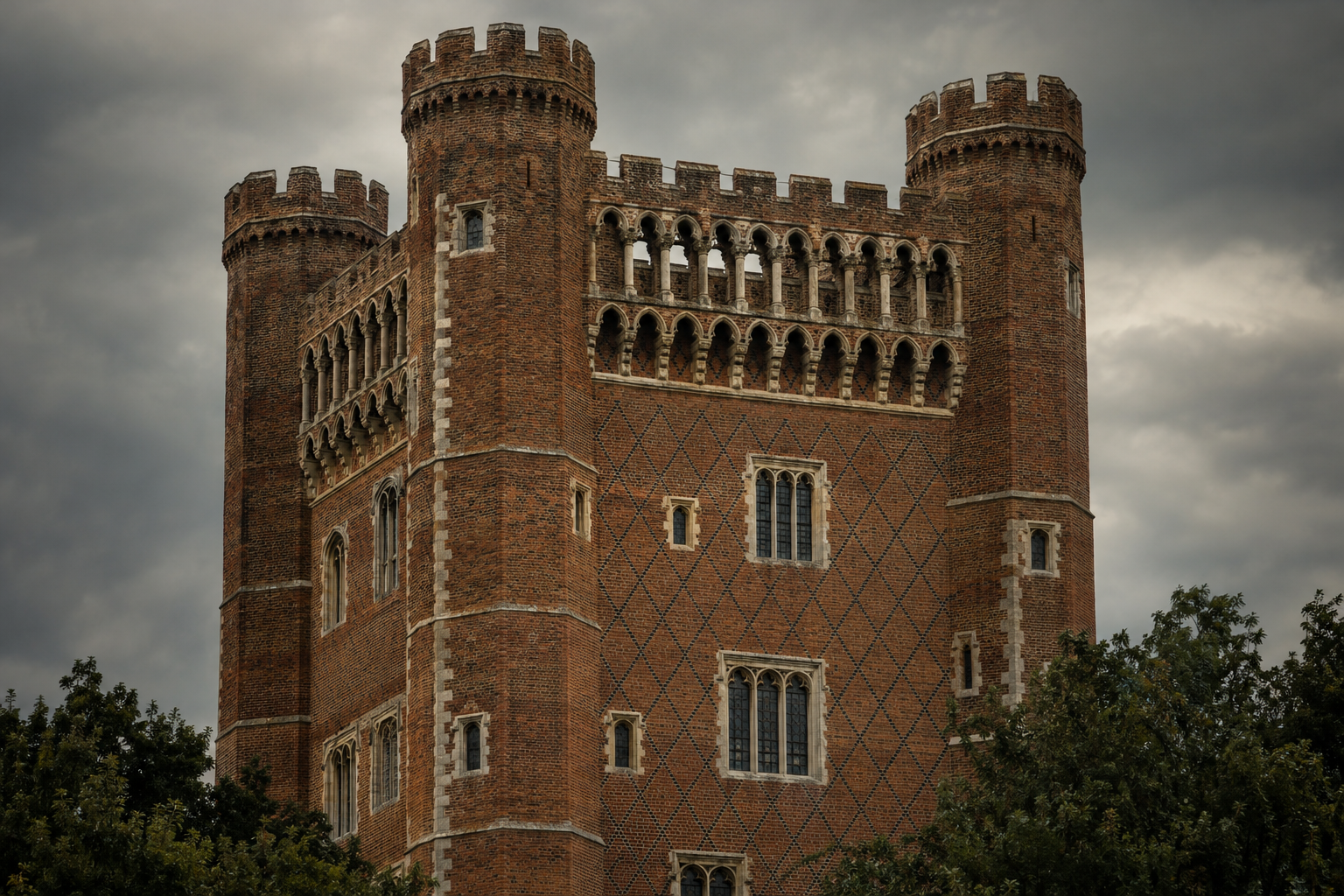
AI-generated illustration · not a documentary photograph
Read Tattershall Castle and Holy Trinity together: patterned brick, medieval glass and Ralph Cromwell’s ambition, with ideas for a wider Lincolnshire history day.
Brick, stone and an ambitious neighbour
Tattershall’s great brick tower makes a forceful first impression, but the enormous church beside it deserves an equal share of your attention. Holy Trinity stands just beyond the castle moat: two very different buildings belonging to one connected story. The castle’s height and patterned brickwork proclaim wealth; the church’s broad spaces and enormous windows give that ambition a religious expression. Looking at them together reveals more than treating either as an isolated monument.
Their shared figure is Ralph, Lord Cromwell, Lord Treasurer of England under Henry VI. Architectural historian James Wright describes a much wider undertaking here, encompassing the castle, collegiate church, school, almshouses and settlement. This was not simply a grand house with a convenient church next door. It was a place shaped to express its patron’s standing.
Source: https://triskeleheritage.triskelepublishing.com/2020/01/16/tattershall-castle-building-a-history/
Before the brick tower
Tattershall’s castle story begins before Cromwell. Robert de Tateshale built a stone enclosure castle with round towers in the 1230s. Although this part of Lincolnshire might look removed from centres of medieval power, the River Witham connected the site with fenland and coastal routes. Materials and people could reach it by water as well as overland.
Cromwell inherited Tattershall in 1419, became Lord Treasurer in 1433 and began an extensive remodelling programme the following year, continuing until about 1450. Surviving accounts record materials arriving from Yorkshire, Leicestershire and Lincolnshire, and the work of masons, carpenters, smiths and other trades. His principal brickmaker, Baldwin Docheman, was probably a continental specialist working clay from nearby Edlington Moor. The tower’s brickwork therefore tells a story of skilled labour and supply networks as well as aristocratic taste.
Source: https://triskeleheritage.triskelepublishing.com/2020/01/16/tattershall-castle-building-a-history/
Look beyond the battlements
The great tower rises 33.5 metres, with projecting octagonal corner turrets and an unusual double-height parapet. Look for the patterned brickwork, known as diaperwork, rather than letting the silhouette take all your attention. Wright’s analysis emphasises that the building’s defensive appearance also served a deliberate display of status.
Inside, the historic arrangement became progressively more prestigious as it rose: storage below, then household and private dining spaces, a great chamber and a bedchamber. Carved chimneypieces and heraldic detail made the message more personal. Cromwell’s Treasurer’s purse appears repeatedly, advertising the office behind his influence. It is a useful motif to remember before turning towards Holy Trinity, where the same emblem occurs again.
Source: https://triskeleheritage.triskelepublishing.com/2020/01/16/tattershall-castle-building-a-history/
Holy Trinity: light with a complicated history
Britain Express dates the beginning of the present large church to around 1466, on the site of a smaller foundation from the 1430s. Its Perpendicular Gothic architecture rewards a slower look: the scale of the transepts, the tracery of the windows and the richly carved stone pulpitum dividing nave and chancel. Niches in that screen once accommodated statuary and altars.
The clear glass is part of the church’s history, not simply a neutral background. Both Britain Express and the National Churches Trust describe the loss of much of the original stained glass and a period when the chancel windows remained unglazed. Their accounts differ over how the removal happened, so the dramatic tale of villagers resisting a sale should be treated as one published account rather than settled fact. Surviving fifteenth-century glass is gathered in the east window, concentrating colour within an otherwise light-filled interior.
Sources: https://www.britainexpress.com/counties/lincs/churches/Tattershall.htm https://www.nationalchurchestrust.org/church/collegiate-church-holy-trinity-tattershall
Small details, less certain stories
The plaque associated with Tom Thumb brings a very different kind of story into this imposing building. The National Churches Trust explicitly treats the extraordinary claims about his height and lifespan as local legend whose factual basis is difficult to untangle. Notice the memorial without assuming every retelling is biography.
The medieval brasses deserve attention too, though visibility cannot be promised. Britain Express recorded protective coverings used to shield them from bat droppings during its visit. That is an observation from a particular visit, not confirmation of their present display.
Sources: https://www.nationalchurchestrust.org/church/collegiate-church-holy-trinity-tattershall https://www.britainexpress.com/counties/lincs/churches/Tattershall.htm
Make the two buildings the centre of the day
Keep the original half-day–full-day allowance, with the castle and church as the core rather than rushing between unrelated stops. A useful sequence is to study the tower’s exterior, explore whichever castle areas are open, then compare its heraldic detail with the church’s carving and glass. This is a suggested order, not a verified walking circuit.
Woodhall Spa provides a wider connection: Wright records a medieval hunting lodge there within Cromwell’s landscape of lordship. The listing’s RAF and Battle of Britain theme offers a later historical contrast, but the supplied evidence does not establish a particular aviation visit or its access arrangements. Keep that extension provisional. Likewise, retain the castle’s public/ticketed status and check church access separately; the National Churches Trust says the church opens when the castle does, but supplies no dated timetable.
Sources: https://triskeleheritage.triskelepublishing.com/2020/01/16/tattershall-castle-building-a-history/ https://www.nationalchurchestrust.org/church/collegiate-church-holy-trinity-tattershall